REVIEW · NICE
Visit Marc Chagall Museum
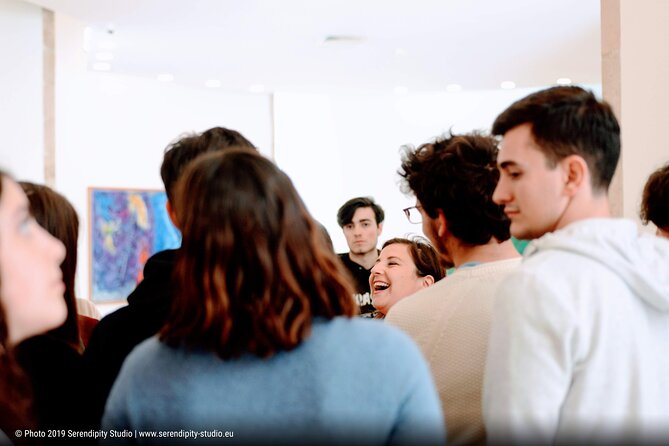
One museum, one message, and lots of symbolism to unpack. This Marc Chagall-focused outing is interesting because the museum was designed for his Biblical Message works, and the garden setting makes the whole experience feel quiet and personal. Two things I like: you get a guided explanation that helps the paintings click, and you also get a chance to pair Chagall with the Cimiez area, including Roman ruins and big views over Nice. One drawback to consider is time, the visit runs about 1 to 2 hours, so if you want to linger on every canvas, you may wish you had more hours.
You meet at 36 Av. Dr Ménard in central Nice and finish back where you started. The tone is very “story-led,” and the English offering means you are not decoding on your own, which matters with an artist like Chagall where symbols do heavy lifting. And if you want an even bigger art day, the format includes the option to upgrade toward the Matisse Museum.
Key things you should know before you go
- Designed for the Biblical Message series, the museum experience is built around Chagall’s spiritual and symbolic themes.
- Guide Marina gets consistently praised for turning paintings into understandable stories and meaning.
- Chagall plus Cimiez gives you art and ancient Nice in one outing, including Roman thermal baths and arenas.
- A calm garden setting helps you slow down and focus, without the chaos of a packed city museum hop.
- Private format means it is just your group, so questions and pace feel easier to manage.
Musée Marc Chagall: Why the building itself shapes the art
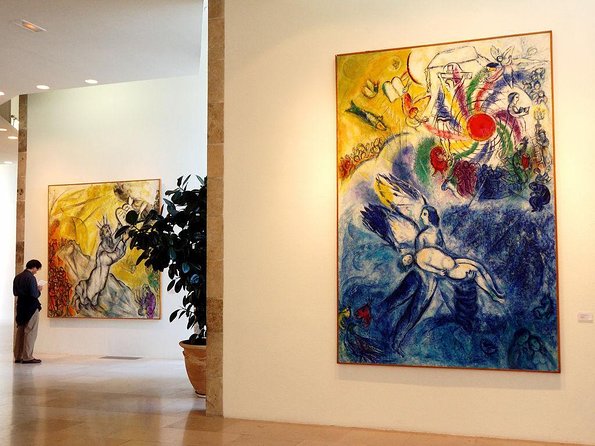
The Marc Chagall Museum in Nice is not a generic “walk through rooms” kind of place. It opened in 1973 while Chagall was still alive, and it was built specifically to display his Biblical Message cycle. That detail changes how you should experience the art.
Here’s how it helps you: when a museum is purpose-designed for a theme, you spend less time trying to figure out what order to read things in, and more time understanding what the artist is trying to say. With Chagall, that matters. His work often mixes faith, memory, romance, and personal history into the same image. The setting does some of that organizing for you, so the story feels less random.
I also like that the museum is described as intimate and garden-like, with a spirituality that is open to interpretation. Even if you do not connect with the religious side directly, the paintings still make sense as personal symbols. The garden atmosphere gives you a calmer rhythm. You are not racing between distant highlights. You are settling in, then letting the paintings do their work.
The guided part that makes Chagall readable
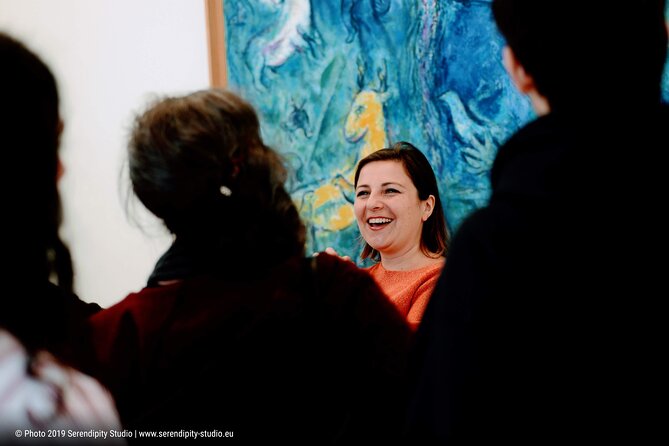
A Chagall museum visit can be hit-or-miss if you go in cold. The paintings are beautiful, but the meaning can stay stuck behind color and symbolism. This is where the guide matters.
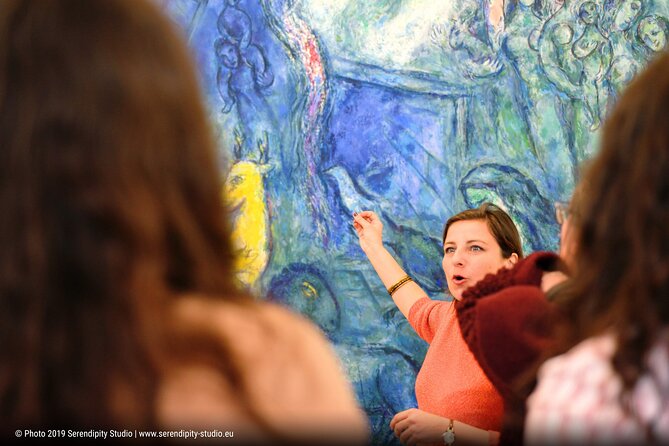
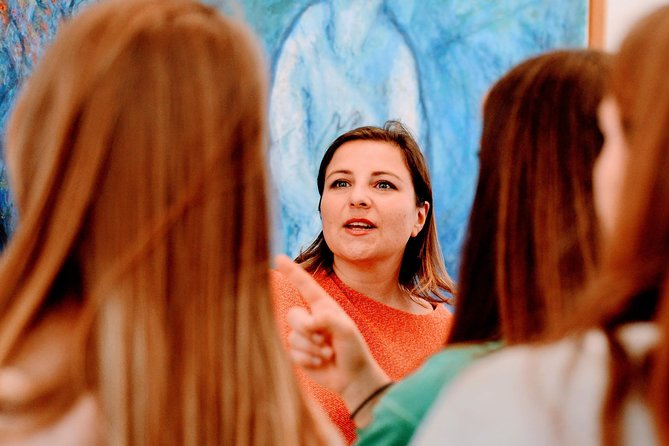
From the guidance you get, the stories focus on both the biblical themes and the personal, emotional side of Chagall’s life. People consistently highlight Marina’s ability to connect works to the man behind them, and to make the symbols and techniques feel logical instead of mysterious.
In practical terms, that means you are not only looking at what is depicted. You are being guided through why certain images, colors, and recurring motifs show up. That also helps you notice details you might otherwise miss. One review focuses on biblical themes paired with personal loves, which is a great reminder that Chagall’s faith themes are not always separate from romance and longing. Another review calls out how the guide broke down symbol meaning and technique relevance. That combination is what turns a museum visit into something you actually remember.
What to expect during your museum time
Your stop centers on the Marc Chagall National Museum and its most important works. Plan on spending enough time to move at a comfortable pace, because Chagall benefits from attention. The guided structure helps you avoid the common problem of only seeing the biggest paintings and missing the way the pieces echo each other.
Also, you are not just doing a look-and-leave. The tour is designed around interpretation. That means the guide will connect what you see with what it represents, and you will end up with a set of “story threads” you can carry into the next room. If you tend to enjoy art when someone gives context, this format is a good fit. If you prefer pure self-guided time, you might still enjoy it, but you may feel pulled toward listening instead of wandering.
Time is the only real constraint. With a duration listed around 1 to 2 hours, you will likely see the main highlights rather than every corner. That can be perfect if you want a focused outing. It can feel short if you are the type who reads labels slowly and then re-checks favorite paintings.
Cimiez after Chagall: Roman thermal baths, arenas, and views
The outing extends beyond the museum to the Cimiez area. That’s a smart pairing, because Cimiez is one of those places where Nice has layers. You get the ancient side, plus quieter religious spaces and a greener feel away from the busiest streets.
The Cimiez portion can include:
- Roman thermal baths and arenas
- A Franciscan monastery
- An olive grove
- Views over Nice
This part is valuable for two reasons. First, it balances the museum’s symbolism with real-world history you can walk through. Second, it gives you a reset. After a concentrated art stop, changing scenery helps your brain process the stories you just heard.
A practical note: the tour format mentions time near 2 hours for the Cimiez component, and there is also a note that the admission ticket is not included. At the same time, the included list mentions an entrance fee. Because that can be confusing, check your booking confirmation carefully so you know what you personally need to pay for, especially for anything beyond the main museum entry.
Optional upgrade: adding the Matisse Museum if you want a bigger art day
If you are the type who thinks one art museum is never enough, the format allows an upgrade tied to the Matisse Museum. Nice is a city where you can build a real “art afternoon,” and combining these two artists gives you a nice contrast.
Chagall’s world tends to lean into personal symbolism and biblical storytelling. Matisse is more about color, form, and design. Even if you do not become an instant fan of either, the pairing helps you see how different artists use similar tools in totally different ways.
If you are short on time, the upgrade might be perfect. If you like museums at a slower pace, just remember that adding a second museum can compress the time you have to really absorb the first one.
Price and what makes this feel like value
The listed price is $216.86 per person, and the experience is private for your group, offered in English, with a set meeting point in central Nice.
Now, what makes this price feel reasonable rather than just “expensive”?
- You are paying for more than entry. You are paying for guided interpretation that focuses on meaning, not just facts.
- The guide approach is consistently praised for connecting Chagall’s life, his symbols, and the paintings’ relevance. That kind of explanation is what you cannot easily replicate with a quick audio guide.
- You also get an added layer with Cimiez, which is not just another room. You are getting a mix of ruins, monastery space, and views.
The main value question is your own style. If you love art when it comes with context, the price starts to make sense fast. If you prefer wandering and skipping interpretation, you could get a cheaper self-guided day elsewhere. But for an art-focused visitor who wants “what am I looking at and why does it matter,” this is built for you.
Logistics that matter in real life
This is not one of those chaotic “meet here, then figure out transport” situations. You meet at 36 Av. Dr Ménard and the tour ends back at the same spot. That makes it easier to plan the rest of your Nice day.
Two more practical points:
- Lunch is not included, so you will want a plan for food either before or after.
- Private transportation is not included, so you are relying on the included route and local access. The experience is described as near public transportation, which helps if you are bouncing between sights.
Also, it is a private activity, meaning only your group participates. That usually makes it easier to ask questions and keep the pace comfortable, especially in a museum where you may want a moment to look closely before moving on.
Who this tour suits best (and who might rethink it)
This experience is a strong match for you if:
- You want art interpretation tied to the real meaning of symbols.
- You enjoy guided storytelling more than label-only reading.
- You like pairing a museum with outdoor sights, like the Cimiez ruins and olive grove area.
It might be less ideal if:
- You hate structured time and prefer to move at your own pace with minimal listening.
- You are hoping for a very long museum day. The tour time is short enough that it will focus on the highlights rather than every corner.
It also works well for solo travelers since it is structured as a private activity, and you still get a guide and pacing rather than feeling lost in a museum maze.
Practical tips before you book
Based on what this outing is built to do, a few tips will help:
- If you care about the Cimiez part, plan your day so you are not rushing immediately afterward, since the outing includes several types of stops in one go.
- If you are sensitive to time, compare your “art pace” with a 1 to 2 hour schedule, and consider whether you want extra independent time in the museum area after the guided portion.
- If you are using an upgrade (like the Matisse Museum), double-check how it affects your total time, since adding stops can reduce how long you spend at each place.
Should you book the Marc Chagall Museum tour with Marina?
I think you should book this if you want Chagall to feel understandable, not just pretty. The museum is designed around the Biblical Message series, but the real advantage is the guided explanations that connect themes to Chagall’s life and the meanings behind symbols and technique. If you are the kind of person who likes to walk away with “I get it now,” this tour is built for that.
You should also consider it if you want a smart Nice combo: art inside, then Roman and religious sites in Cimiez outside, with olive trees and views.
The only reason to pause is time. If you want hours and hours with no structure, this might feel short. But if you want a focused, story-led art outing that also gives you a taste of ancient Nice, it is a solid pick.
FAQ
How long does the Marc Chagall Museum visit take?
The duration is about 1 to 2 hours.
Where does the tour start?
The meeting point is 36 Av. Dr Ménard, 06000 Nice, France.
Is the tour offered in English?
Yes, the tour is offered in English.
Is this a private tour?
Yes. Only your group will participate.
What is included in the price?
It lists GST (Goods and Services Tax), government fees, and an entrance fee.
Is lunch included?
No, lunch is not included.
Is private transportation included?
No, private transportation is not included.
Is the experience near public transportation?
Yes, it is described as near public transportation.
What is the cancellation policy?
You can cancel for a full refund up to 24 hours in advance of the experience start time.
What happens if the minimum number of travelers is not met?
If it is canceled due to not meeting the minimum, you will be offered a different date or a full refund.